Reskill Rewire's 3 Pillars: The Core Skills To Stay Ahead in the Age of AI
Savage
11/26/20255 min read
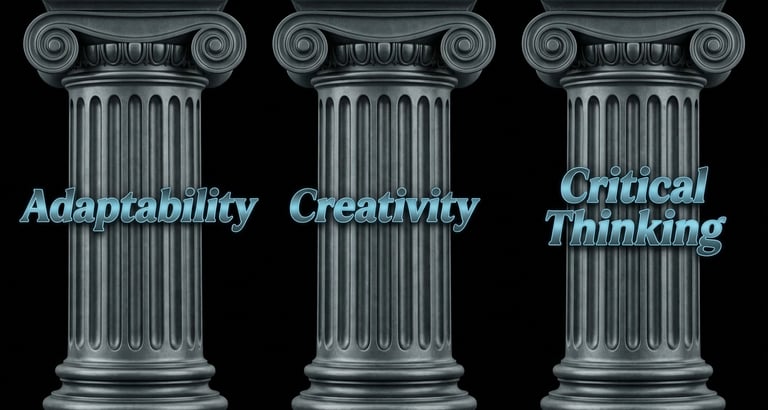
TLDR: In the AI age, machines handle routine tasks, but humans must master Adaptability, Critical Thinking, and Creativity to define the problems and pivot strategies. This post shows you the tactical frameworks (Reskill) and the necessary psychological shifts to overcome the fear of constantly changing job requirements (Rewire). Your professional longevity depends on these three human-centric, future-proof skills.
Welcome to the framework
The secure career path you followed, whether in government or a large corporation, was built on stability, predictable processes, and deep expertise in a fixed domain. The AI Age, however, is defined by relentless, compounding change. Technology is no longer a tool; it is a disruptive force that commoditizes fixed expertise. For the risk-averse professional, this feels like an earthquake of career transitions.
To survive and thrive, you cannot simply learn a new software; you must cultivate Versatility (the new currency of employment). This requires a dual approach: Reskill to adopt powerful frameworks for problem-solving, and Rewire to embrace the constant discomfort of the unknown, the primary psychological obstacle for those leaving secure employment.
RESKILL Section: Acquiring New Capabilities
Focus Keywords: Versatile Skills, Adaptability Frameworks, Critical Thinking, Creative Problem Solving, AI Age Skills.
The new job description for all human professionals is "Strategic Pivot Operator." Your most valuable assets are the cognitive frameworks that allow you to analyze a novel situation, invent a novel solution, and execute the shift. We are acquiring the T.A.C. System (Tactical Adaptability & Creativity). Mastering these versatile skills is key to staying ahead in the AI Age.
Mastering Adaptability: The Continuous Learning Loop
Adaptability is not a personality trait; it is a learned, intentional process. To make it actionable, you must establish a cycle of continuous learning and recalibration to stay relevant.
Skill Audit: The T-Shaped Professional. Your deep expertise (the vertical bar) remains valuable, but you must define the broad proficiency (the horizontal bar) in adjacent concepts like basic data literacy, ethical AI use, and prompt strategy. For example, a former finance director's "T" vertical is financial modeling; the horizontal is understanding how generative models affect market trends and creative problem solving.
The 70-20-10 Learning Model. Structure your skill acquisition to force action over passive consumption: 70% from challenging, on-the-job assignments; 20% from mentorship and social learning; 10% from formal coursework or certifications. This combats the common tendency toward perpetual, low-stakes online course consumption.
Actionable Framework: SCAMPER for Creativity.
Sharpening Critical Thinking: Beyond the Obvious Answer
Critical Thinking is the process of asking better questions than the AI can. It is about evaluating the relevance and accuracy of the data or solution presented, ensuring high-quality decision-making.
Data Vetting Protocol: Implement a three-point vetting process (Analysis, Evaluation, Synthesis) when presented with any data-driven conclusion, especially from AI tools. Analysis: Break the argument into its core assumptions. Evaluation: Question the source data, the model’s bias, and the potential for hallucination (ask, "What contextual factor is missing from this data set?"). Synthesis: Combine the AI insight with your human, contextual experience for an actionable, responsible conclusion.
First-Principles Reasoning: This is the most vital step. Strip away analogies, historical precedent, and assumptions. Ask, "What is the absolute, most fundamental truth I know about this problem, independent of the way we have always solved it?" This prevents you from simply automating a flawed, outdated process.
Activating Creativity: Generating Novel Value
Creativity is the human differentiator. It is the ability to generate a valuable, novel idea, often by leveraging constraints. In the AI Age, this means defining the boundaries that steer the machine toward innovation.
Constraint-Based Ideation: Learn to frame inquiries that force generative AI to push past the average. Use "What if" and "How might we" questions with deliberate limitations (e.g., "How might we communicate this regulatory change to the public using only three sentences and no legal jargon?"). You provide the innovative parameters; the AI handles the execution volume.
Cross-Pollination Matrix: Identify two completely separate, successful models or processes from unrelated industries (e.g., a triage process from a hospital ER and a customer segmentation model from retail). Force them to intersect in a matrix to generate novel process ideas for your domain.
The Integration Bridge
You now have the technical framework: a structured approach to continuous skill auditing, critical analysis, and constraint-based creation. But as you apply this, you will notice a fierce internal resistance, specifically the Fear of Incompetence, which is rooted in losing the status of the "expert" who always knew the answer. That is where your upgraded operating system kicks in.
REWIRE: Upgrading Your Operating System
Focus Keywords: Cognitive Flexibility, Loss Aversion, Growth Mindset, Career Resilience, Identity Shift.
The most significant barrier to versatility is the psychological toll of constantly being a beginner. Former long-term professionals often find their identity tied to knowing all the answers. The Rewire is about releasing the ego’s attachment to expertise and shifting to a Learning Identity to build true career resilience.
System Upgrade: Releasing the Ego’s Hold on Expertise
Your brain treats the loss of status like a psychological threat, leading to resistance to new tasks. You must redefine the source of your professional longevity.
Identity Shift Protocol: Reframe your core professional identity from "The Person Who Knows Everything About X" to "The Person Who Can Figure Out Anything." This immediately moves you from defending a fixed skill set to validating a flexible, powerful process, turning new challenges into fuel for your new identity and fostering a growth mindset.
The "Productive Failure" Protocol: Design small, low-stakes experiments that you expect to fail, and explicitly celebrate the quality of the data the failure produced. This psychologically de-stigmatizes setbacks, reclassifying them as necessary information gathering, not personal flaws. The objective is to fail smarter, not less often.
Micro-Win Conditioning: Avoid chasing large-scale, months-long goals initially. Dedicate just 30 minutes daily to learning a single, small concept or function in a new tool, and record that victory in a "Learning Log." This micro-conditioning habit builds neurological momentum and counters the pervasive feeling of irrelevance.
What The Science Says
The psychological obstacle you face is Loss Aversion, a cognitive bias suggesting the pain of losing something (your established career status, your fixed knowledge base) is psychologically twice as powerful as the pleasure of gaining something new. To counteract this, we leverage Cognitive Flexibility, the brain's ability to switch between different concepts, rules, and problem-solving strategies. Consistent, varied practice (random-order practice, as opposed to blocked-order) physically strengthens the neural pathways required for adaptability, making it easier to pivot with less mental fatigue and improving career resilience.
Today's Actions
You now have the T.A.C. System (technical framework) AND the Learning Identity (mindset shift). Use them together.
Technical Steps (Reskill)
Define Your T-Shape: Map your deep expertise and define three adjacent AI/data skills you must acquire for your broad proficiency (the horizontal bar).
Run a SCAMPER Drill: Take one current problem and apply the SCAMPER framework (Substitute, Combine, Adapt, Modify, Put to another use, Eliminate, Reverse) to generate five non-obvious solutions.
Execute the 70-20-10 Audit: Identify one major skill acquisition gap and find a way to learn $70\%$ through a current work project, $20\%$ via a mentor, and $10\%$ via an online course.
Mindset Steps (Rewire)
Write the New Identity: Physically write down the statement, "I am The Person Who Can Figure Out Anything," and place it where you see it every morning.
Schedule Productive Failure: Block 30 minutes this week to deliberately try a new tool or framework with the intention of documenting what went wrong, not what went right.
Start a Micro-Win Log: At the end of each day, write down one small, specific thing you learned, adapted to, or successfully figured out.
The Viral Share & Accountability Protocol
The pursuit of versatility is often a solitary, fear-driven journey, but it should not be.
The Who Needs This Trigger: You know one former colleague, one friend from the corporate or government track, who is currently struggling with this exact fear, the feeling that their decades of expertise are suddenly irrelevant. Forward this post to them right now with the subject line, "I thought of you. Let's do this."
The Accountability Science: The American Society of Training and Development (ASTD) found that if you simply commit your goals to someone, your success rate jumps to 65%. If you establish a specific, scheduled accountability appointment with that person, your success rate soars to 95%. Ask the person you just forwarded this to to be your accountability partner.